Arabic and English Real Estate Websites: A Decision Guide
👉 Book a free 30-minute consultation
The UAE property market speaks many languages, but for most agencies the first big decision is Arabic and English. Some of your buyers, landlords and investors are more comfortable reading in Arabic. Developers and government partners may expect it. And a well-built Arabic version can reach searches that an English-only site never appears for.
Done badly, though, a second language can do more harm than good: half-translated pages, broken layouts, and forms that send Arabic enquiries to agents who cannot reply in Arabic. This decision guide walks through the choices behind a bilingual Arabic English real estate website, in the order you should make them.
Decision 1: Do you need a full Arabic version now?
Start with your audience, not your competitors. Look at the enquiries you already receive. Ask your agents how often clients prefer to talk in Arabic. Check whether your target communities, developers or partners expect Arabic materials.
- Go full bilingual if a meaningful share of your clients prefer Arabic, or if you work with developers and government-linked partners that expect it.
- Start with key pages if demand is real but smaller: home, about, services, contact and your most important project or area pages.
- Wait if you cannot yet answer Arabic enquiries quickly. A translated site with nobody to respond creates disappointed leads.
Decision 2: Translation or localisation?
Translation converts words. Localisation adapts the message. An English headline built on a wordplay will not work when translated literally, and the details Arabic-speaking clients look for first may differ from what English-speaking clients look for.
Whichever route you take, have a fluent Arabic speaker with real estate knowledge review every page. Machine translation can be a starting point, but property terms, community names and legal wording need a human check.
Decision 3: How to structure the URLs
Google recommends using different URLs for each language version rather than switching language with cookies or browser settings. The common options are:
| Option | Example | Pros | Cons |
|---|---|---|---|
| Subdirectory | yoursite.ae/ar/ | Easy to set up, one site to maintain | Both languages share one setup, so separation is harder |
| Subdomain | ar.yoursite.ae | Easy separation, can be hosted differently | More moving parts to manage |
| Separate domain | a second domain for Arabic | Complete separation | Two sites, more infrastructure and cost |
| URL parameter | yoursite.ae?lang=ar | Quick to add | Not recommended by Google |
For most brokerages, a subdirectory is the simplest choice to run well. Whatever you choose, link the language versions with hreflang annotations so search engines show the right page to each searcher.
Decision 4: How visitors switch language
Google advises against automatically redirecting people to a language version based on what you think their language is. A visitor in Dubai using an English browser may still prefer Arabic, and the reverse is just as common. Instead:
- Put a clear language switch in the header of every page.
- Link each page to its exact equivalent, not back to the homepage.
- Keep each page in one language. Google uses the visible content to work out the page language and advises against side-by-side translations.
Planning an Arabic version of your site? Book a free 30-minute consultation and we will help you decide the scope and structure.
Decision 5: How much design work RTL needs
Arabic reads right to left, so the layout should mirror, not just the text. Plan for:
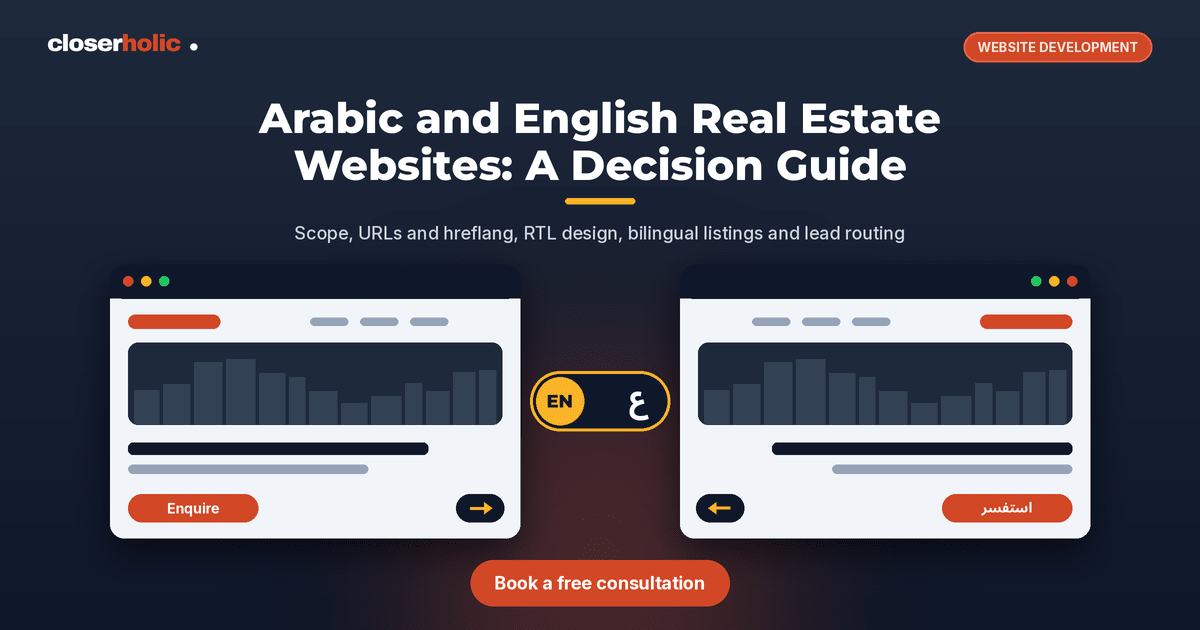
- Mirrored navigation and layout: menus, breadcrumbs, sliders and arrows flip direction.
- Arabic fonts that read well at small sizes on phones, paired with your brand fonts.
- Mixed content: prices, phone numbers, unit references and English brand names inside Arabic text must still display correctly.
- Forms: labels, error messages and placeholder text translated, with phone fields that accept international formats.
Test on real phones too. Many buyers browse listings on mobile, as we explain in mobile-first real estate websites for UAE buyers.
Decision 6: Where Arabic listing content comes from
Static pages are the easy part. Listings change daily, and nobody wants to translate them twice. The cleanest approach is to store Arabic titles and descriptions as fields on the property record in your CRM, next to the English ones, and let the website pull both. Then a price change is made once and appears in both languages.
Decide who writes Arabic listing copy, who approves it, and what happens when a listing has no Arabic version yet. A simple rule, such as showing the English description with a short Arabic note, is better than an empty page.
Decision 7: How Arabic enquiries reach the right agent
This is where many bilingual sites fall short. Add a hidden or visible language field to every form, so the CRM knows which version of the site the enquiry came from. Then route it:
- Arabic enquiries go to an Arabic-speaking queue or agent.
- Automatic acknowledgements go out in the client's language.
- Managers can report on enquiries by language to see whether the investment is paying off.
If you use Bitrix24, CRM forms can sit on each language version, and Open Channels can distribute chats to different queues, for example one for Arabic-speaking agents.
A simple decision checklist
- Confirmed demand and capacity to answer in Arabic
- Scope agreed: full site or key pages first
- Localisation and review process in place
- URL structure chosen and hreflang planned
- Language switch on every page, no forced redirects
- RTL design tested on mobile
- Arabic listing fields in the CRM
- Forms and routing set up by language
For the wider picture of what your site needs, see real estate website development in the UAE, and for campaigns, our comparison of brokerage websites and landing pages.
How Closerholic helps
Closerholic designs and builds real estate websites for UAE agencies and developers, connected to Bitrix24 CRM. We help you scope the Arabic version, plan URLs and hreflang, design proper RTL layouts, feed bilingual listings from the CRM, and route enquiries to the right agents, so your second language brings real leads, not extra work.